15-min Free Demo
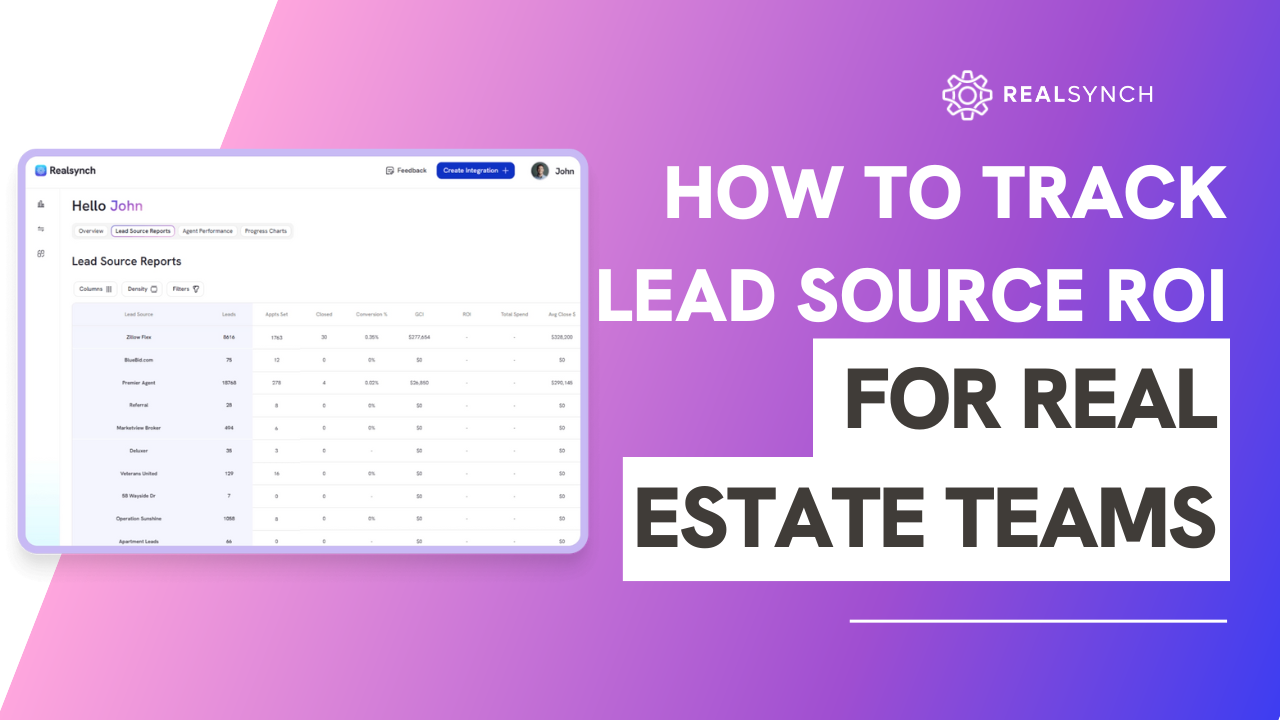
Most real estate teams are spending thousands per month on lead generation, but can’t answer one fundamental question: Which lead sources are actually producing profit?
This isn’t just a minor gap—it’s a major operational blind spot. Without clear ROI tracking, teams routinely overspend on underperforming lead sources while ignoring their most profitable channels. The result? A marketing budget that undermines growth instead of fueling it.
As market competition intensifies and real estate cycles lengthen, measuring lead source return on investment (ROI) is no longer optional—it's a strategic imperative. In this article, we break down how real estate teams can accurately track ROI across their entire funnel, avoid common pitfalls, and implement tools that automate the entire process.
Why Lead Source ROI Tracking Matters
Tracking cost per lead is easy. But focusing solely on that number can be misleading. What matters most is cost per closing. A $20 lead that never converts is far more expensive than a $100 lead that results in a sale.
Long sales cycles (typically 4-6 months in real estate) further complicate attribution. When teams judge campaign performance too early, they risk cutting high-potential channels prematurely. Smart teams don’t just track leads—they follow the full journey from lead to revenue.
"A $15 lead that never converts is infinitely more expensive than a $100 lead that closes."
Accurate ROI tracking allows teams to reallocate 30-40% of their budget toward high-performing sources—a move that often marks the difference between stagnation and sustained growth.
Key Metrics for Accurate ROI
To fully understand which channels are producing real value, teams need to track the entire conversion funnel:
1. Cost Per Lead (CPL): Total Marketing Spend ÷ Number of Leads 2. Contact Rate: Leads Contacted ÷ Total Leads 3. Appointment Rate: Appointments ÷ Contacts 4. Close Rate: Closings ÷ Appointments 5. Cost Per Closing: Marketing Spend ÷ Number of Closings 6. GCI by Source: Gross Commission Income attributable to each source
These metrics provide a comprehensive picture—from initial spend to final commission.
The Real Estate ROI Formula
Once data is collected, the ROI formula is straightforward:
ROI = [(GCI - Marketing Cost) ÷ Marketing Cost] x 100
Example:
- Monthly Spend: $1,000
- Leads: 30
- Closings: ~9 annually (0.75 per month)
- Avg. GCI: $5,000
- Annual GCI: $45,000
- Annual Cost: $12,000
- ROI = [($45,000 - $12,000) ÷ $12,000] x 100 = 275%
A 275% ROI means earning $2.75 for every dollar spent—a strong performance indicator.
Manual vs. Automated Tracking
Manual spreadsheet tracking is feasible for small teams but quickly becomes unsustainable. It requires hours each week, is error-prone, and lacks real-time visibility.
CRM-based tracking improves workflow but is often limited to a single platform and may not integrate with accounting systems, leaving gaps in true profit analysis.
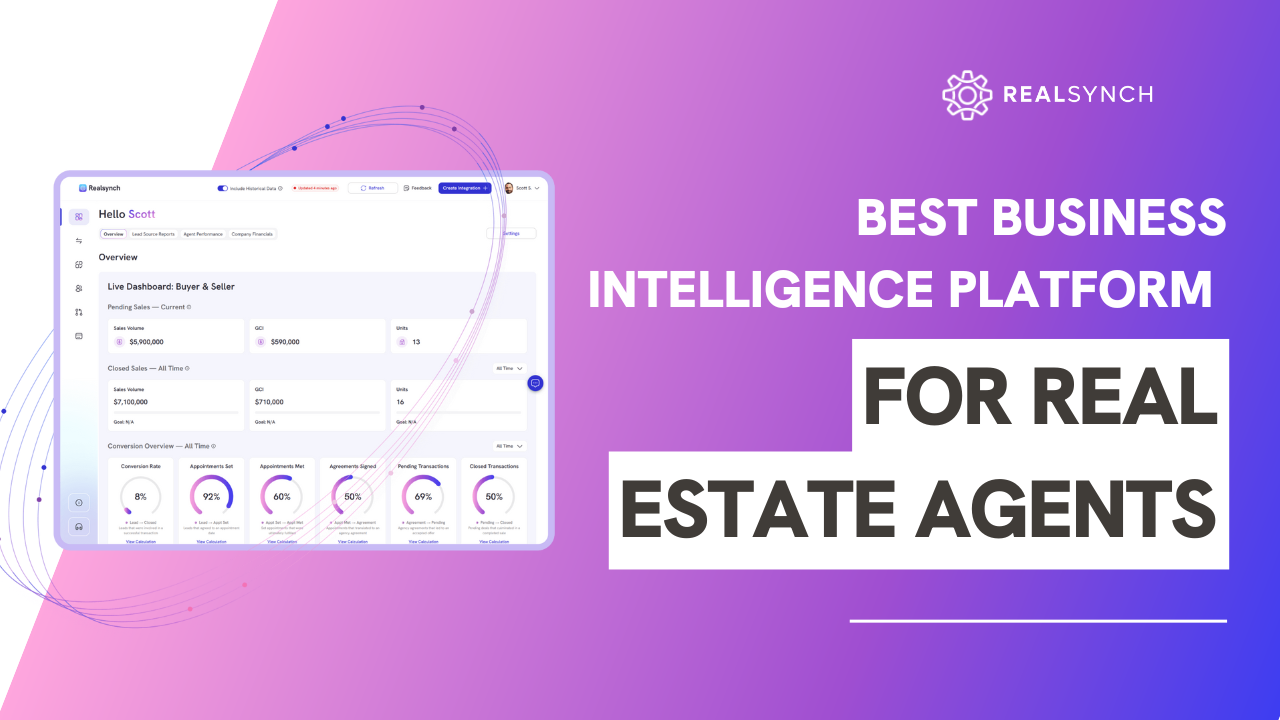
Automated business intelligence platforms like RealSynch BI bring data from all systems into a unified dashboard. RealSynch integrates with Follow Up Boss, BoomTown, kvCORE, Sierra Interactive, and Skyslope, as well as financial tools like QuickBooks to provide complete ROI visibility.
"RealSynch connects lead data to financial outcomes—automatically, accurately, and without manual work."
Understanding Attribution in Real Estate
Buyers today engage across multiple touchpoints before converting. Using single-touch attribution (first or last interaction) misrepresents how leads actually convert.
Time-decay attribution is preferred. It gives more weight to recent interactions while still accounting for earlier steps in the journey. This model reflects how real estate transactions actually unfold.
Implementation in Six Steps
- Audit Your Sources: Document every paid and organic lead source and monthly spend.
- Define Your Metrics: Choose standardized metrics (CPL, close rate, etc.) and use time-decay attribution.
- Tag Every Lead: Use consistent naming and UTM tracking for digital sources.
- Link Financial Data: Connect transactions and actual GCI to original sources.
- Create a Reporting Cadence: Weekly (volume), Monthly (conversion), Quarterly (ROI & budgeting).
- Automate It: Use platforms like RealSynch BI to eliminate manual tracking and scale insights.
Common Mistakes to Avoid
- Judging campaigns too early (less than 90 days)
- Focusing only on CPL without downstream metrics
- Inconsistent source tagging
- Excluding hidden costs (subscriptions, labor)
- Relying on single-touch attribution models
The Next Generation of ROI Tools
RealSynch has expanded beyond dashboards to offer a full intelligence stack that helps teams capture more leads and coach more effectively:
- IDENTIFY™: Captures anonymous website traffic, enriches visitor data, and auto-triggers follow-up across SMS, email, and ad platforms.
- AI COACH™: Grades calls and appointments, flags missed objections, and delivers actionable coaching notes.
- MOMENTUM™: Uses gamification—contests, leaderboards, streaks—to boost call activity and agent output.
- PULSE™: Wearable device that captures in-person appointment conversations and syncs key insights directly to your CRM and Google Drive.
"From first click to final close, RealSynch tools let you track, coach, and convert more effectively than ever."
Conclusion
Tracking lead source ROI isn’t just about efficiency—it’s about clarity. With the right tools, your team can stop chasing vanity metrics and start doubling down on what works.
RealSynch helps real estate teams connect lead gen to actual GCI without the manual grind. The result? Smarter spending, better coaching, and a stronger bottom line.
Learn how RealSynch automates ROI tracking and boosts performance. Request a Demo